The Journal
The Sovereignty of Shadow
Chiaroscuro, Tenebrism and the Atmosphere of Perception
Chiaroscuro, Tenebrism and the Atmosphere of Perception
In the history of visual art, few techniques possess the enduring gravity of chiaroscuro. Derived from the Italian chiaro and oscuro — light and darkness — the term describes far more than tonal contrast alone. It is an aesthetic philosophy: a way of revealing form through concealment, of shaping emotion through restraint, of allowing the visible world to emerge gradually from obscurity.
Long before the invention of photography, painters understood that illumination acquires meaning only in relation to shadow. Light without darkness merely describes. Light emerging from darkness transforms.
This tension continues to shape my own work.
In nature, the most arresting moments rarely occur beneath the neutrality of midday sun. They emerge at thresholds: when mist dissolves detail, when dusk begins to absorb the landscape, when rays of light briefly isolate an animal before it disappears again into foliage or rain. In those moments, the natural world becomes less documentary and more elemental.
The photograph ceases to record. It begins to suggest.
Tenebrism and the Emotional Weight of Darkness
Within the broader tradition of chiaroscuro lies a more radical expression: tenebrism.
Where chiaroscuro models form through gradual tonal transition, tenebrism embraces darkness as a dominant structural force. Earlier painters had explored dramatic contrast before, but Caravaggio transformed these experiments into a fully realised visual language in which subjects emerge from shadow with startling immediacy.
Backgrounds collapse into obscurity. Spatial certainty dissolves. Light no longer behaves as ordinary illumination but as revelation itself — selective, almost metaphysical.
What makes tenebrism enduringly powerful is not simply its drama, but its psychological precision. Darkness withholds information, and the unseen begins to exert greater emotional pressure than the visible. The eye searches instinctively beyond the illuminated figure, sensing that reality continues outside the limits of perception.
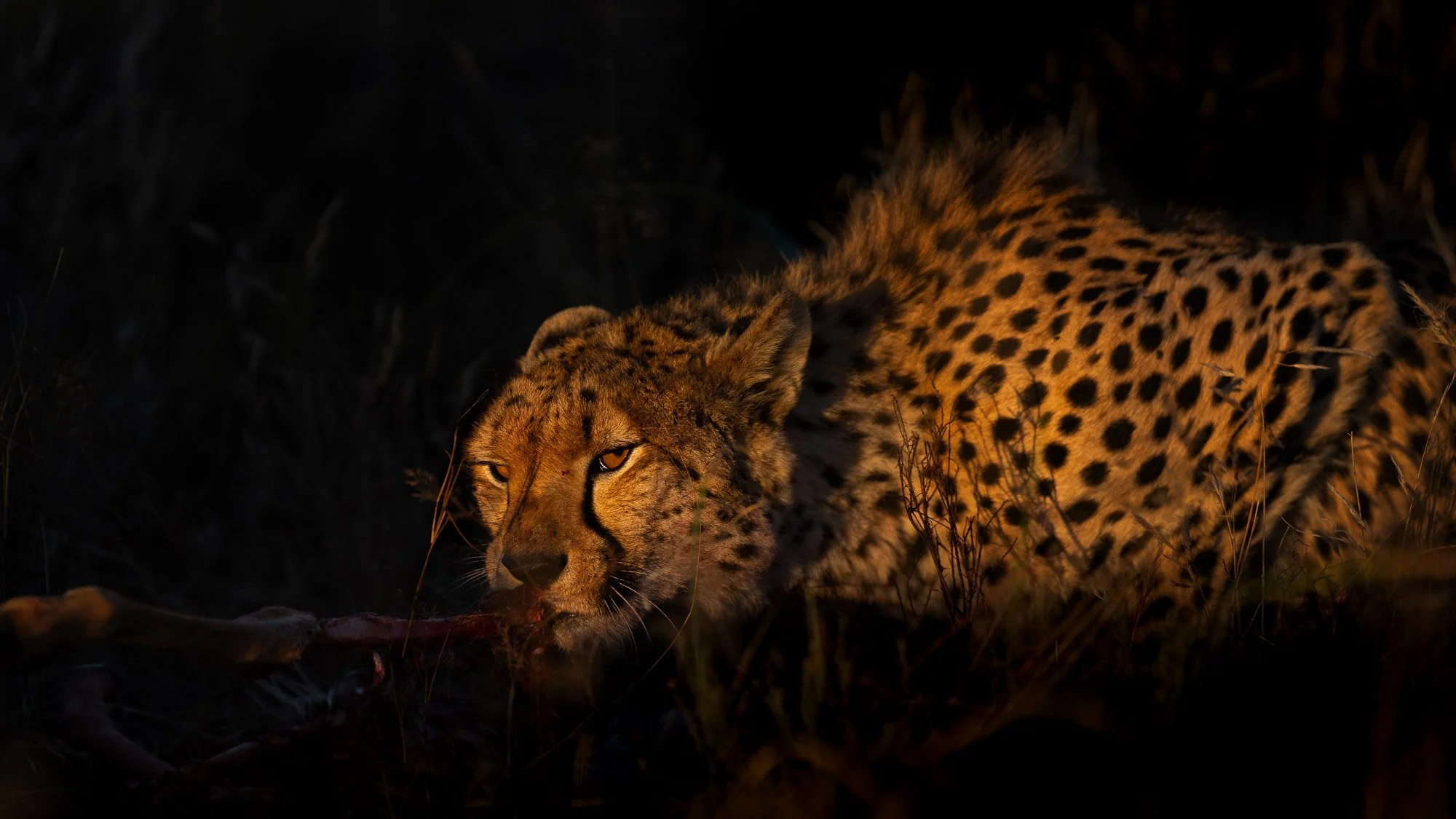
This principle remains central to low-key photography. By reducing visual excess, the image acquires concentration and atmosphere. A single illuminated contour — antlers appearing through fog, the edge of a wing catching dawn light, the fleeting outline of a gorilla emerging from volcanic mist — gains extraordinary presence when suspended within shadow.
Darkness edits the image. It removes distraction until only what is essential remains.
Yet shadow does more than simplify composition. It alters the relationship between viewer and subject. An animal partially concealed by darkness resists complete possession by vision. The photograph no longer presents wildlife as spectacle or inventory, but as something sovereign and elusive — a living presence that exceeds full comprehension.
Only what remains partially hidden retains mystery.
The Ontology of Darkness
A remark often associated with Rembrandt captures something essential about this tradition: that he began his paintings from darkness itself, building form outward from a darkened ground rather than merely applying shadow afterward.
Whether literally true or not, the idea reveals a deeper philosophical intuition. Darkness is not simply the absence of light. It is the condition from which light acquires significance.
Across mythology, literature, and philosophy, darkness repeatedly appears not as negation but as origin.
In Theogony, the primordial goddess Nyx emerges near the beginning of existence itself, older than the Olympian order that follows her. Night is not secondary to creation. It precedes it. From Nyx arise Sleep, Death, Dreams, and Fate — as though the deepest structures of human experience emerge from darkness itself.
In Paradise Lost, John Milton invokes “Old Night” as an ancient substrate underlying creation. Hell becomes a realm of “darkness visible,” one of the most extraordinary phrases in English literature because it grants darkness density, atmosphere, and almost material presence. Shadow becomes perceptible in itself rather than merely the failure of illumination.
And in the Rigveda, the Nasadiya Sukta describes the beginning of existence with the haunting line:
“Darkness there was, hidden by darkness, in the beginning.”
Here darkness exists before even the distinction between being and non-being. It is not emptiness, but undifferentiated potential — a concealed totality from which reality itself emerges.
Again and again, shadow appears as the hidden ground of revelation.
Perhaps this explains why chiaroscuro feels psychologically precise. Human beings never encounter reality in complete clarity. We move through fragments of understanding surrounded by uncertainty, memory, intuition, and obscurity. The visible world is always partial.
As Martin Heidegger later suggested, truth emerges not only through revelation, but through concealment.
Great chiaroscuro acknowledges this condition rather than resisting it.
Light reveals objects; shadow reveals depth.
Modernity and the Fear of Darkness
Modern culture increasingly treats darkness as something to eliminate.
Cities are overlit. Interiors are flooded with uniform illumination. Digital culture rewards perpetual visibility and immediate disclosure. The contemporary world strives toward total legibility.
Yet excessive illumination often produces not clarity, but exhaustion.
When everything is visible, nothing retains depth.
This is partly why shadow now feels restorative. Darkness slows perception. It interrupts the endless demand for information and allows experience to recover atmosphere, silence, and interiority. Chiaroscuro reminds us that concealment is not opposed to truth. In many cases, it is what allows truth to acquire emotional force at all.
Reality itself is unevenly illuminated.
In Praise of Shadows
Few writers articulated this sensibility more precisely than Jun'ichirō Tanizaki in In Praise of Shadows.
Tanizaki argued that beauty does not reside solely in the object itself, but in the subtle gradations of darkness surrounding it — in suggestion, obscurity, texture, and atmosphere. Shadow, in his view, was not absence but refinement.
He believed modernity’s increasing brightness flattened perception. Excessive illumination dissolved nuance and erased delicate relationships between silence, materiality, and time. Darkness, by contrast, allowed objects to breathe.
This idea often returns to me while photographing wildlife. The unseen matters as much as the revealed. A photograph becomes more evocative when it leaves space for uncertainty — when the viewer senses that the world extends beyond the frame and beyond visibility itself.
The shadow is not emptiness. It is atmosphere.
Burke and the Sublime Force of Obscurity
The philosopher Edmund Burke approached darkness differently. For Burke, obscurity was not primarily refined but sublime.
In his theory of the sublime, he argued that partial concealment intensifies emotional experience because the imagination expands into what cannot be fully seen. He famously observed:
“To make anything very terrible, obscurity seems in general to be necessary.”
The insight extends far beyond fear alone. Obscurity magnifies awe, scale, and mystery precisely because it resists containment. A fully visible object feels finite. A partially hidden one feels inexhaustible.
This helps explain why shadow remains so emotionally potent in visual art. Darkness does not diminish reality. It enlarges it.
The viewer no longer passively receives the image. They enter into it imaginatively, completing what the light leaves unresolved.
These ideas did not remain confined to painting or philosophy. The ontology of shadow migrated naturally into cinema.
The Language of Shadow in Cinema
The visual language of shadow found one of its most powerful modern expressions in film noir. Few films embody this more completely than The Third Man.
Set within the fractured atmosphere of postwar Vienna, the film employs deep shadow, severe tonal contrast, and fragmented illumination not merely as visual style, but as psychological architecture. Darkness ceases to function as background and becomes an active moral environment. Streets dissolve into blackness. Faces emerge only partially. The unseen continually exerts pressure upon the frame.
Film noir inherits tenebrism not simply aesthetically, but metaphysically.
Shadow becomes ambiguity itself — moral, emotional, existential.
Shadow as Presence
This tradition has profoundly shaped my own approach to photography. I am less interested in complete description than in atmosphere and partial revelation. The aim is not to present wildlife as fully knowable, but as something ancient, sovereign, and resistant to complete visibility.
In the rainforests of Uganda, light occasionally breaks through dense canopy for only a few seconds before vanishing again into cloud and foliage. A gorilla briefly emerges from darkness and then recedes back into it. What remains afterwards is not informational completeness, but heightened awareness — the recognition of encountering something that exceeds the frame itself.
Likewise, the final rays of evening light may ignite the fur of a tiger while the surrounding landscape dissolves into shadow. The contrast does more than dramatise form. It creates emotional tension between revelation and concealment, presence and disappearance.
To reveal everything is often to diminish mystery.
In shadow, the animal resists becoming entirely reducible to image.
Bringing Shadow into the Contemporary Interior
Though rooted in Renaissance painting, chiaroscuro feels remarkably contemporary within interior spaces today. In an age saturated with brightness and visual noise, restraint acquires a restorative quality.
Shadowed imagery introduces atmosphere rather than mere decoration. It alters the emotional character of a room without demanding constant attention. Instead of overwhelming a space with visual information, it creates stillness.
This is where the philosophies of Tanizaki, Burke, and Caravaggio quietly converge: all recognise that darkness is not mere absence, but presence in itself.
Within interiors shaped by minimalism, wabi-sabi aesthetics, or biophilic design, shadow is not a deficiency to be corrected but a condition to be preserved. Silence, ambiguity, and incompleteness become part of the atmosphere of the space itself.
Perhaps this is why shadow endures: it reminds us that reality exceeds what can fully be seen.
The Architecture of Stillness
How Fine Art Nature Photography Transforms Interior Design
How Fine Art Nature Photography Transforms Interior Design
There is a moment, in the best interiors, when a room becomes more than a composition of furniture, textures, and architecture. It begins to breathe. The atmosphere settles. Silence acquires weight. The space feels lived in before anyone has entered it.
Often, that transformation happens through art.
Not decorative art chosen merely to coordinate with a palette, but work with emotional gravity — images that slow the eye and reward contemplation. In recent years, fine art nature photography has emerged as one of the most sophisticated ways to create this effect within contemporary interiors. Particularly in luxury spaces, collectors and designers are increasingly turning toward monochrome landscapes, atmospheric wildlife studies, and moody natural scenes to bring depth, stillness, and permanence into the home.
Unlike trend-driven décor, fine art photography offers something rarer: atmosphere.
For collectors drawn to refined interiors, thoughtful wildlife and nature photography can become the emotional center of a room. The challenge lies in balance. How does one integrate the untamed spirit of the natural world into a refined architectural environment?
The answer lies in stillness, restraint, and the mastery of light.
The Architecture of Stillness
Traditional wildlife photography often seeks movement, rarity, or spectacle. My own work moves in another direction.
I have become increasingly interested in the suspended moments between movement — the moments where atmosphere becomes more important than action itself. A solitary animal emerging from darkness. Fog dissolving into shadow. Quiet light softening across water, feathers, or textured skin.
These images reveal themselves slowly.
In a luxury interior, this kind of stillness acts almost architecturally. A restrained composition provides visual breathing space within a room, allowing surrounding materials — stone, linen, wood, plaster, shadow — to coexist harmoniously with the artwork rather than compete against it.
Negative space becomes essential here.
In photography, emptiness is rarely absence. It is structure. Darkness surrounding a solitary subject creates psychological scale. Mist obscuring detail introduces ambiguity that encourages prolonged attention rather than instant consumption.
This relates closely to the Japanese concept of ma — the meaningful use of emptiness or interval. In both architecture and photography, what is omitted often becomes as important as what is shown.
A room requires visual pause in much the same way music requires silence between notes.
Why Nature Photography Works So Well in Luxury Interiors
The modern luxury interior has moved away from excess. The most compelling homes today feel curated rather than decorated — restrained, tactile, intentional.
Increasingly, luxury is no longer defined by abundance, but by atmosphere.
Modern life produces unprecedented visual and cognitive noise. Screens, movement, advertising, information, and constant stimulation compete endlessly for attention. As a result, many people no longer want homes that merely impress visitors. They want spaces that restore calm.
This helps explain the growing appeal of biophilic interior design and contemplative interiors more broadly. Thoughtful nature photography introduces organic presence without visual chaos. It creates emotional stillness without becoming sterile.
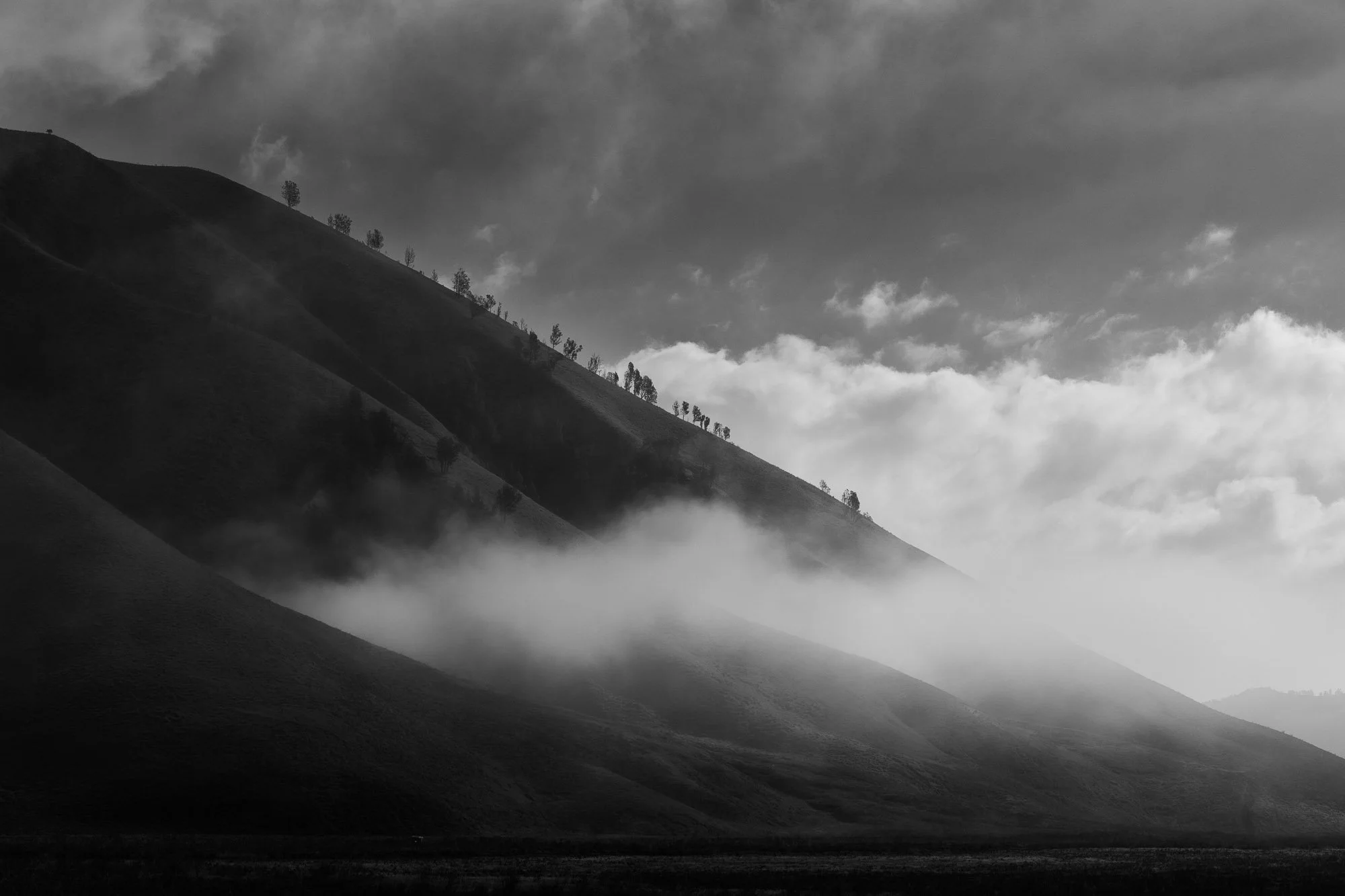
A mist-covered mountain ridge in monochrome.
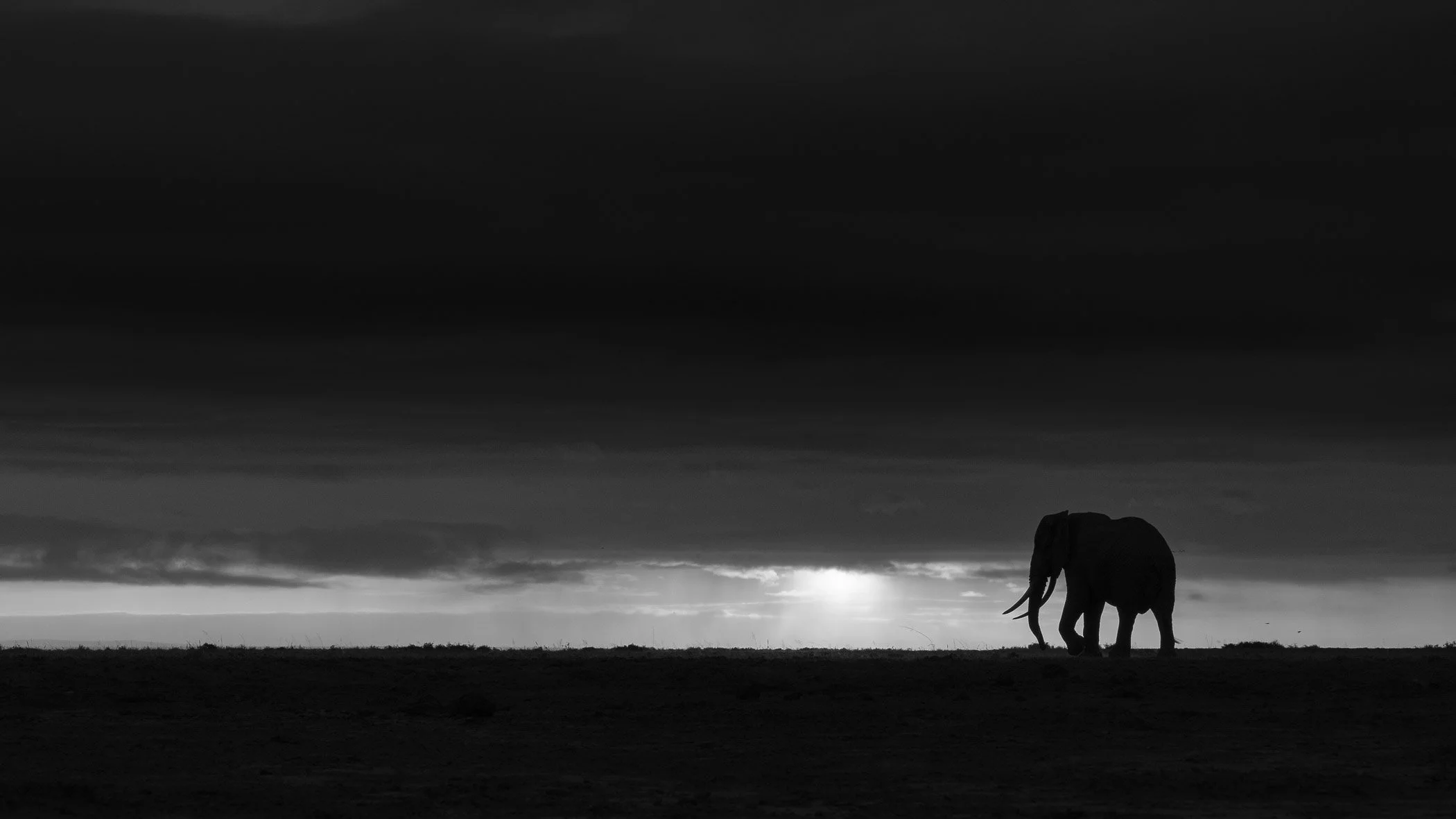
A solitary animal emerging from shadow.
The soft gradation of light across an elephant’s hide.
These images quiet a room psychologically.
This is especially true for monochrome and chiaroscuro photography. Strong contrast, darkness, negative space, and restrained palettes allow artwork to coexist elegantly with architecture rather than overpower it. Rather than demanding attention through spectacle, the image deepens the atmosphere of a space quietly.
In refined interiors, subtlety often creates the strongest impact.
The Power of Darkness and Shadow
Contemporary interiors often prioritize brightness and openness, yet shadow plays a profound role in how we experience calmness, intimacy, and atmosphere.
Darkness slows perception.
It softens visual noise and introduces psychological depth that overly illuminated spaces often lack. This is one reason moody photography and low-key monochrome imagery work so naturally within sophisticated interiors.
The Japanese writer Jun’ichirō Tanizaki observed in In Praise of Shadows that beauty often emerges through partial concealment rather than total exposure. Luxury interiors frequently operate according to the same principle. Atmosphere is rarely created through excess illumination. It emerges through softness, texture, restraint, and shadow.
Fine art photography that embraces darkness complements this beautifully because it behaves similarly. It invites contemplation rather than immediate consumption.
Shadow creates intimacy.
And intimacy is often what transforms a beautiful room into a memorable one.
The Difference Between Decorative Prints and Fine Art Photography
Many interiors contain imagery. Far fewer contain art that changes how a space feels.
Decorative prints are often selected to fill a wall. Fine art photography is selected to create resonance.
The distinction matters.
A thoughtfully produced fine art wildlife photograph carries patience, observation, composition, and intentionality. The image reflects not only what was seen, but how the subject was experienced emotionally. It asks something of the viewer beyond a passing glance.
Collectors increasingly seek this depth because homes themselves are becoming more personal and psychologically expressive. People want spaces that reflect sensibility and emotional identity rather than trend cycles.
Quiet photographs possess unusual longevity within a home precisely because they do not exhaust themselves immediately.
They deepen over time.
This is one reason monochrome wildlife photography often feels timeless. Without the descriptive immediacy of color, the viewer focuses more intensely on gesture, texture, form, and light. The image becomes less about documentation and more about presence.
A well-crafted photograph begins to function almost architecturally — shaping mood, rhythm, and emotional tone within a room.
Choosing the Right Nature Photography for Different Interior Styles
The most successful interiors create harmony between architecture, materiality, and artwork. Fine art photography should feel integrated into the atmosphere of a room rather than added afterward.
Minimalist Interiors
Minimal spaces benefit enormously from monochrome wildlife photography and restrained natural scenes.
In minimalist interiors, every object carries greater visual weight. A single large-scale photograph with strong negative space can anchor an entire room while preserving its calmness. Images featuring fog, shadow, snow, dark water, or tonal restraint work particularly well because they deepen atmosphere without disrupting spatial quietness.
Thin black frames, museum-style floating frames, and natural oak finishes complement these interiors beautifully.
Warm Contemporary Interiors
Contemporary interiors with textured linens, stone, dark woods, and earthy palettes pair exceptionally well with moody nature photography.
Photographs featuring dramatic light, deep shadow, rain, mist, or atmospheric weather conditions create intimacy and sophistication without overwhelming the room. Wildlife portraits in low-key lighting can become striking focal points while still preserving architectural restraint.
A photograph does not merely add visual interest. It shapes how a room feels to inhabit.
Classic or Transitional Interiors
Traditional interiors benefit from timeless imagery with tonal restraint.
Monochrome landscapes, elegant wildlife studies, and contemplative natural compositions integrate naturally into classic architecture because they avoid trend-based palettes. Fine art photography printed on museum-grade paper often feels surprisingly harmonious alongside antique furniture, textured plaster walls, or historic details.
Again, the key is restraint.
Sophisticated interiors rarely require many artworks. One exceptional piece placed thoughtfully often creates more impact than an entire gallery wall.
Scale and Materiality
One of the most common mistakes in interior design is choosing artwork that is too small.
Large-scale fine art photography creates immersion. The viewer does not merely observe the image; they enter its atmosphere.
This is particularly true for monochrome and wildlife photography, where texture, shadow detail, and tonal transitions carry much of the emotional weight. Oversized prints allow these details to emerge gradually as one moves through a room.
In luxury interiors, scale creates presence.
A large monochrome wildlife portrait above a console or fireplace can completely define the emotional character of a space. Smaller works, meanwhile, can become deeply intimate when placed thoughtfully in bedrooms, hallways, reading corners, or layered shelving compositions.
Materiality matters equally.
Museum-grade cotton papers, matte surfaces, delicate highlights, soft blacks, museum glass, and refined framing all contribute to how a photograph is experienced within architecture. Luxury is often perceived tactilely rather than through excess.
The softness of cotton rag paper.
The absorption of matte blacks.
The quiet reflection of museum glass.
These details distinguish fine art photography from mass-produced wall décor.
Why Black-and-White Photography Feels Timeless
Color photography can be extraordinary, but monochrome possesses a unique permanence within interiors.
Without color, the eye moves differently.
Light becomes sculptural.
Texture becomes tactile.
Shadow acquires emotional depth.
Black-and-white nature photography removes distraction and emphasizes form, gesture, atmosphere, and light. This is one reason monochrome integrates so effortlessly into minimalist, contemporary, wabi-sabi, and classic interiors alike. It speaks the same tonal language as architecture itself — stone, wood, linen, plaster, shadow, and natural light.
For wildlife photography especially, monochrome creates an almost sculptural quality. Fur, feathers, mist, water, and darkness acquire extraordinary texture and presence.
A well-crafted monochrome print feels less like decoration and more like an object of contemplation.
Bringing Stillness Back Into the Home
Perhaps the growing resonance of fine art nature photography reflects something larger than interior design trends alone.
Modern culture increasingly rewards speed, immediacy, visibility, and stimulation. Yet human beings remain psychologically shaped by silence, weather, darkness, rhythm, and natural scale.
The home therefore becomes more than a designed environment. It becomes a form of refuge.
Art plays a profound role in shaping this refuge because imagery influences attention itself. Some artworks intensify mental noise. Others quiet it.
Thoughtful wildlife and landscape photography reconnects us with slowness, atmosphere, and observation. A solitary animal in shadow or a quiet landscape in mist reminds us of something increasingly absent from contemporary interiors: contemplation.
The best interiors are rarely the loudest.
They are the spaces that continue speaking quietly long after one has left them.
That is where fine art nature photography transcends decoration.
It becomes atmosphere.
Presence.
A quiet form of luxury.
.
The Quiet Power of Nature
Why We Are Drawn to Nature in Art
Why We Are Drawn to Nature in Art
Human beings have returned to nature in art for thousands of years.
Long before the development of cities, philosophy, or written language, people painted animals on cave walls with remarkable sensitivity and care. Across centuries and civilizations, artists continued to depict forests, mountains, rivers, wildlife, storms, birds, trees, and changing light with almost inexhaustible fascination. Styles changed, religions evolved, and entire civilizations disappeared. Yet nature remained one of art’s most enduring subjects.
This persistence suggests something deeper than aesthetic preference.
People are drawn to nature in art because nature speaks to fundamental aspects of human experience: stillness, wonder, vulnerability, beauty, solitude, mystery, and our connection to something larger than ourselves. Philosophers, artists, and — more recently — psychologists have all attempted to explain why encounters with the natural world affect us so profoundly.
Perhaps nature in art continues to resonate because it reminds us of something modern life too easily obscures.
Nature at the Beginning of Art
Some of the earliest surviving artworks in human history depict animals.
The Paleolithic paintings at Lascaux Cave and Chauvet Cave — created more than 17,000 years ago — portray horses, bison, deer, rhinoceroses, and lions with extraordinary movement and attention. Even earlier, the prehistoric Sulawesi cave pig painting, discovered in Indonesia and believed to be among the oldest known figurative artworks, suggests that animals occupied a central place in human imagination long before recorded history.
Human figures appear rarely in many early cave paintings. Animals dominate.
Even now, these images feel strangely immediate. In the flicker of torchlight against stone, early humans traced the shape of animals they lived beside, depended upon, and feared. The paintings suggest that animals were not seen merely as resources or dangers, but as beings worthy of reverence, fascination, and observation.
In many ancient cultures, nature carried spiritual significance. In Ancient Egypt, animals became intertwined with mythology and religion: falcons symbolized divine kingship, cats protection, and ibises wisdom. In Chinese landscape painting, mountains, rivers, and mist were not simply scenery, but expressions of harmony between humanity and the cosmos.
Nature in art was rarely decorative alone. It reflected humanity’s attempt to understand its place within the world.
Towards Emotional Presence
By the Renaissance, artists increasingly explored nature as emotional experience.
Leonardo da Vinci studied animals obsessively, sketching birds, horses, and cats with extraordinary sensitivity. Yet these works were more than anatomical studies. They reveal fascination with movement, vitality, and the mysterious intelligence of living beings. Nature became something not only symbolic, but emotionally and philosophically significant in itself.
Later, painters such as Diego Velázquez imbued animals with an almost haunting presence. His Head of a Stag is not merely a depiction of an animal, but a meditation on solitude, mortality, and dignity. Emerging from darkness, the stag feels both vulnerable and monumental — less an object of observation than a quiet emotional encounter.
During the Romantic period of the eighteenth and nineteenth centuries, nature acquired renewed emotional intensity. Industrialization transformed European society rapidly, and many artists and writers feared modern life was distancing people from wilderness, silence, and contemplation.
Artists such as Caspar David Friedrich painted landscapes filled with fog, forests, ruins, and distant horizons. These works were not simply landscapes, but reflections on solitude, transcendence, and humanity’s smallness within the natural world. A figure standing before a dark sea or a mountain disappearing into mist became an image of introspection itself.
These ideas continued into modern art. Franz Marc believed animals possessed a spiritual immediacy modern humanity had lost. His paintings of deer, horses, and foxes attempted to express emotional truths through nature — not as escape from reality, but as a way of reconnecting with something deeper and more instinctive.
Contemporary fine art photography inherits much of this tradition. Though the medium has changed, the impulse remains remarkably similar: to preserve fleeting encounters with stillness, atmosphere, wilderness, and the emotional presence of the natural world.
Philosophers on Nature and the Human Spirit
Philosophers across centuries repeatedly returned to nature because they believed it nourished something essential within human life.
The ancient Greek philosopher Aristotle saw nature as inherently meaningful and worthy of contemplation. For him, observing nature cultivated wisdom because it revealed order, harmony, and beauty beyond human construction.
Centuries later, Jean-Jacques Rousseau argued that civilization often alienated humanity from its natural state. Nature represented emotional authenticity and simplicity in contrast to the artificiality of society.
Few thinkers articulated the psychological importance of nature more beautifully than Henry David Thoreau. In Walden, he described wilderness not as escape, but as necessity:
“We need the tonic of wildness.”
Thoreau believed forests, solitude, and silence restored clarity and perspective lost in modern life.
Friedrich Nietzsche similarly sought mountains and wilderness as places free from distraction and conformity. Nature, for Nietzsche, stripped away performance and forced confrontation with oneself.
More recently, the writer and philosopher John Berger suggested that animals continue to fascinate modern humans because they represent a connection to a world increasingly absent from contemporary life. In his essay “Why Look at Animals?”, he described animals as among humanity’s earliest companions in imagination, myth, labor, and symbolism.
These philosophers differed enormously, yet many arrived at similar intuitions: human beings need contact with nature and with other living beings because such encounters restore perspective, humility, presence, and emotional depth.
Nature and the Modern Mind
In recent decades, psychology and neuroscience have increasingly supported ideas philosophers intuited centuries earlier.
Researchers studying environmental psychology have found that exposure to nature can reduce stress, improve concentration, and support emotional well-being. Importantly, studies suggest that even representations of nature — including paintings and photographs — can produce measurable benefits.
One influential framework, “Attention Restoration Theory”, developed by psychologists Rachel Kaplan and Stephen Kaplan, proposes that natural environments help restore mental attention depleted by modern overstimulation.
In a landmark study published in Science in 1984, researcher Roger Ulrich found that hospital patients recovering from surgery healed faster and required less pain medication when their windows overlooked trees rather than brick walls.
Subsequent research has linked exposure to nature imagery with reduced stress, lower anxiety, improved mood, and greater emotional regulation.
These findings help explain why nature continues to occupy such an important place in art and interior spaces alike. People do not simply admire nature aesthetically; they respond to it psychologically and emotionally.
Why Nature in Art Endures
Across philosophy, psychology, and art history, one idea appears repeatedly: human beings are deeply connected to the natural world.
Now that many of us are further removed from nature than ever before, the longing for that ancient connection may have only deepened. Perhaps this is why nature continues to move us so deeply in art.
A landscape can evoke silence and perspective. An animal can evoke presence, mystery, and vulnerability. A forest, a bird in flight, mist over water, or light moving across stone can momentarily interrupt the speed and noise of contemporary life.
For thousands of years, artists have attempted to preserve those moments.
And for thousands of years, people have continued to seek them out.